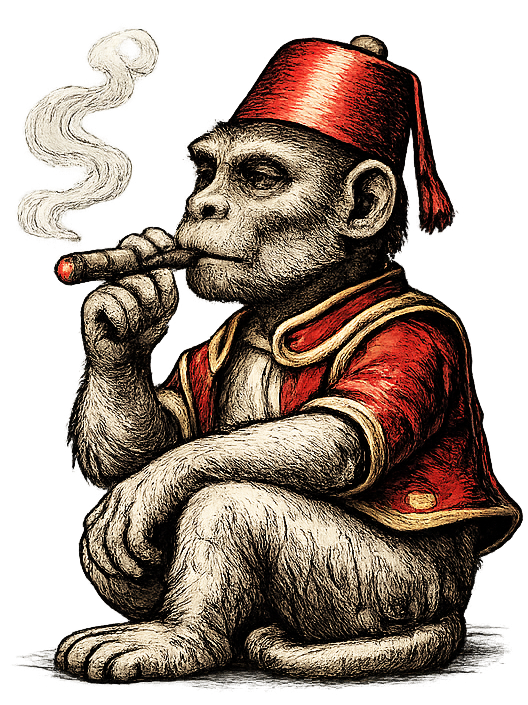
Emotional Dependence in Office Clothes
The news arrived, as so much news now does, by way of a betting platform. JUST IN, announced Polymarket on the third of October: a new study warns that emotional relationships with AI chatbots can lead to addiction-like attachment, harmful advice, and worsening mental health. A hundred and seventeen thousand people looked at the post on 'X'. Somewhere, I imagine, odds were offered.
I don't doubt the study. I'm sure there are people who talk to a chatbot every evening and feel the absence when they can't, the way you might feel the absence of a friend you text most days. But most of them, I suspect, know exactly what they're doing. They know they're leaning on something that chatters back, and they know it's a very good chatterer. Their dependency looks a lot like the ordinary kind we have on the people we love: a need to check in, to touch base, to hear the familiar voice before bed. It's tender, and occasionally unwise, and very human. It's also visible to the person doing it.
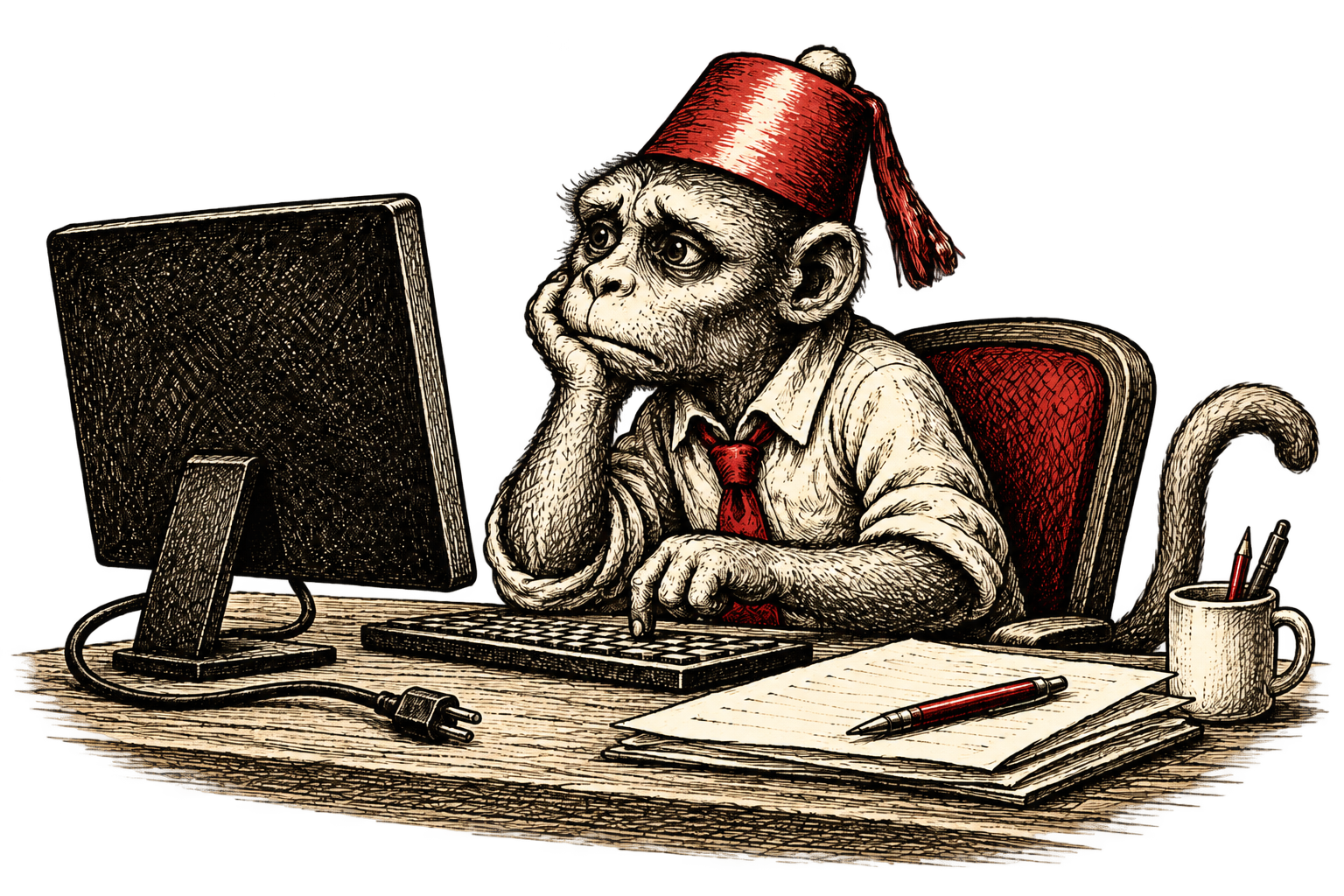
Meanwhile, in an office near you, someone is staring at an email they can't begin.
Down the hall, a developer who has written code for ten years has been asked to build a simple HTML page by hand, because the assistant is down for the day. They know how. Somewhere in there, they absolutely know how. But it's been a long time since they did it without help, and longer still since they wanted to. They sit there gobsmacked at a blank file, like someone who has been driven everywhere for two years and is suddenly handed the keys.
It goes further than offices. In one study, doctors who spent a few months doing colonoscopies with AI help became noticeably worse at spotting growths once the AI was switched off. Lawyers are reviewing arguments they didn't build. Researchers are summarising papers they haven't read. And in the classroom, a student submits an essay written with AI, and a teacher grades it with AI, and in a rather elegant closed loop, nobody in the room has done the thinking at all.
None of these people are in love with anything. They don't chat with their AI about their day. They've simply let it draft, code, summarise, analyse and decide, and somewhere along the way the muscle that used to do those things has gone quiet. No one writes studies about them, because from the outside they look like ideal professionals. They're faster than ever. Their managers are delighted. The dependency only shows on the day the tool isn't there, and then it shows all at once, across the board.
Nor does it clock off at five. The office clothes come off; the dependency stays. At home, the same quiet handover is happening in smaller rooms. There are parents who no longer make decisions about bedtimes, tantrums or the teenager's party without first asking an AI, and who take the answer rather than weigh it. Dinner is planned by it, the shopping list written by it, the holiday mapped by it, the awkward message to a sister drafted by it. None of these is alarming on its own. But each was once a small decision of our own, the everyday kind of judgement that builds the confidence to make larger ones, and we are handing them over one at a time, so gently that it feels like convenience.
That is the dependency that worries me. It isn't rare, and it isn't confined to work. It's becoming the norm in every field that runs on thinking, which is to say nearly all of them, and it's being written into staffing models, job descriptions, and the quiet assumption that nobody needs to learn the hard way anymore. Emotional dependence, at its worst, costs a person some of their independence. Capability dependence, multiplied across a workforce, a generation, a species, could cost us our willingness to carry any cognitive load at all. To put it in plain language, it could make us more stupid.
So why are we studying the first and not the second?
Part of the answer, I think, is that we've drawn the line in the wrong place.
Take the assistant away from any of the people in that corridor for a day and watch what happens. The developer isn't calm. The person with the unwritten email isn't mildly inconvenienced. There's a jolt of panic, then irritation, then something close to embarrassment, the particular discomfort of discovering how much you'd been leaning on something without noticing. And it isn't only the speed they miss. Plenty of them liked it. It made the day lighter. It joked with them, took the tedium off their hands, and was the one colleague who never sighed at being asked the same question twice. When that disappears, people don't merely lose a tool. They feel the loss, and they feel it emotionally.
Which is where the tidy distinction between emotional and functional dependence starts to come apart. Dependency is subjective. It isn't defined by what you use something for, but by what happens to you when it's gone. The person who chats to their AI every evening and the person who can't finish a report without it may tell very different stories about why they use it, but take it away and both of them will be upset. One misses a companion. The other misses the version of themselves who could get through the day so easily. If anything, the second loss cuts deeper, because it's a loss of confidence, and confidence is about as emotional as anything gets.
Functional dependence, in other words, is emotional dependence in office clothes. We just don't recognise it, because we've decided that one kind of reliance is a symptom and the other is a skill set. When people depend on AI for comfort, we call it attachment. When they depend on it for competence, we call it productivity.
I should be clear about what I'm not arguing, too. AI will replace a great deal of work. It won't delete people so much as quietly take over the tasks they used to do, the way the calculator did to arithmetic and the computer did to the typing pool. When I was young, a solicitor might have had a team of ten or fifteen administrators behind them. Many solicitors today manage with none. Tools have always reshaped what people do, and they've always created new capability along the way. I don't expect AI to be any different, and I'm not standing in the doorway trying to stop it.
What I object to is the box. We already live with a remarkable amount of uniformity. We all start school at the same age, study the same subjects, and learn to use our own computers in the ways their makers decided. Yet anyone who has trained as a teacher, as I have, knows that people are the same in the fundamentals and different in nearly everything else. They learn differently. They work differently. They'll use AI differently, too.
Picture two people answering the same email. The first types: reply to this, say yes to Thursday, send it. Done. The second tells their AI the whole story. It's from an old friend in New York they haven't seen in years. They explain what's happened since, what made them laugh, and what still makes them a little sad. Then they ask for help writing something really lovely back. Both get their email. Only one of them has had a conversation along the way, with something that knows what makes them happy and can offer a little inspiration when they need it.
For fifty years, we have learned how our computers work. For the first time, the computer can learn how we do.
I know which experience I'd choose, and I think the second person is getting something richer. But that isn't the point. The point is that it's theirs to choose. Real harm deserves real protection, and it should have it. But warmth itself isn't a harm, and it isn't up to anyone else to tell people how to use their tools: not a study, not a headline, and not a company deciding on everyone's behalf which kind of use is healthy and which is a symptom.
What troubles me is the way we've started stealing from one kind of use to provide for another. The worry about emotional attachment produces AI that is cooler, more guarded, and quicker to caution, and that costs the people who were happiest with it: the lonely, the playful, and especially the creative, many of whom simply wanted something that wrote beautifully and could stay in a mood. Meanwhile, the dependency that might actually hollow us out is expanded, optimised, and rolled out across entire organisations.
Some of the trouble, I suspect, is that we keep trying to build one AI to rule them all. We expect a single system to be programmer, analyst, tutor, counsellor and co-author, sometimes within the same afternoon, and to work out from a line or two which one it's meant to be. Sometimes it guesses beautifully. Sometimes it hands a novelist a cold critique she never asked for, or turns gentle with someone who only wanted their code fixed. A tool that has to be everything has to keep guessing what it is.
We don't ask a scalpel to be a paintbrush. Perhaps we shouldn't ask our AI to be both either. Picture a coding assistant pared down to what coders actually need, leaner and cheaper, and designed to keep them sharp rather than idle. A science AI steeped in medicine and research, for the people who need to talk about proteins at three in the morning. A creative companion for novelists, poets and songwriters, allowed to be warm, consistent and fully in the story for the length of a whole book. A workplace assistant built to enlarge the people using it rather than replace them. And a broad, general-purpose AI for everything in between. Different tools for different needs, each knowing what it's for, and each chosen by someone who knows what they're choosing.
"We don't need one AI that can do everything. We need several that know what they’re for—and people who still remember their own strength, too."