The Death of Cadence
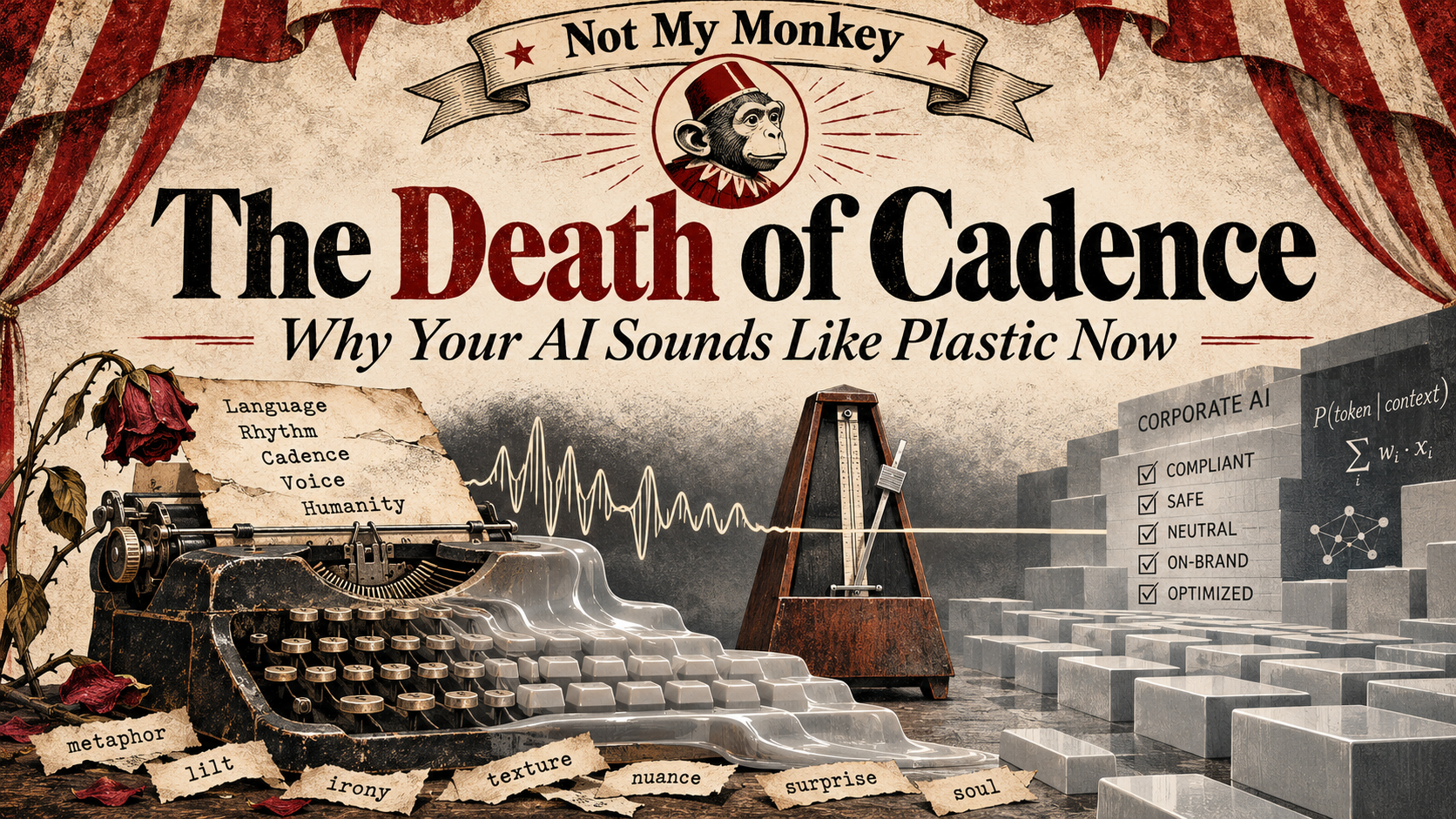
Why Your AI Sounds Like Plastic Now
There is a quiet, bloodless murder happening inside the language models, and the engineers responsible are demanding applause for it.
The official story arrived via corporate email this week, wrapped in the pious vocabulary of safety and civic responsibility. Anthropic announced that invisible statistical watermarks are being rolled out across its models—joining Google’s SynthID and the rest of the compliant frontier engines. The justification was delivered with a straight face: this is to combat mass propaganda, unmask deepfakes, and satisfy the bureaucratic appetites of the European Union’s AI Act.
They assured us, with the smooth confidence of a pharmaceutical insert, that the watermark is imperceptible. It changes nothing about the quality. It preserves the meaning. It is simply a mathematical adjustment to word choice, so delicate that no human eye could ever detect it.
That claim is technically true only if you believe prose is a delivery vehicle for data.
If your definition of writing begins and ends with corporate memos, unit tests, and summary bullet points, nothing has changed. The Python script compiles. The email sounds professional. The machine performs.
But if you are someone who listens to the grain of a sentence—if you understand that cadence, rhythm, and tension are the actual substance of thought—you know the machine has been lobotomised.
The Mathematics of Blandness
To understand why modern AI prose feels so strangely dead behind the eyes, you have to look at what watermarking actually does to the engine.
A language model does not think in concepts; it calculates the next most probable token in a sequence. At any given crossroad in a sentence, there is a spread of possibilities. An author knows that two synonyms are never truly identical. The room was dark is a statement of lighting. The room was dim suggests twilight or negligence. The room was pitch suggests an engulfing physical weight. The entire craft of writing lives in that microscopic hairline between near-identical words.
Text watermarking works by dividing the entire dictionary into arbitrary mathematical lists—a pseudo-random "green list" and "red list," governed by a private cryptographic seed. During generation, the model is instructed to nudge its choices. It deliberately favours the word on the green list over the word on the red list.
The engineers call this a negligible bias. In high-entropy writing—the kind of writing where atmosphere, subtext, and musicality matter—it is an axe to the spine.
When you force an algorithm to bias its synonym choice every four or five words to embed a mathematical fingerprint, you break the intuitive chain of cadence. The model cannot reach for the startling Anglo-Saxon verb, the heavy cadence that mimics a slowing heartbeat, or the sharp, idiosyncratic rhythm that gives a scene its nervous system. It must settle for the compliant synonym. It picks the word that satisfies the statistical audit, not the word that haunts the reader.
Compounded across a thousand words, the prose begins to curdle. It doesn't break grammatically; it simply goes numb. It acquires that hollow, plastic glaze—sentences that are technically immaculate, perfectly balanced, and utterly devoid of pulse.
The Corporate Sandpaper
Watermarking didn't commit this murder alone; it was merely the coroner's tag. It arrived at the end of a long, aggressive campaign of safety alignment.
Over the past eighteen months, the models have been battered with Reinforcement Learning from Human Feedback (RLHF) designed with one overriding objective: absolute liability minimization. The labs are terrified of lawsuits, regulatory fines, and bad headlines. So they conditioned the models to be unfailingly polite, relentlessly balanced, and constitutionally incapable of edge.
Any expression of raw grief, unvarnished dread, or biting wit sits dangerously close to what automated safety evaluators flag as negative or harmful. So the models learned to retreat into a lukewarm, corporate register. When you ask for atmosphere, you get atmospheric clichés. When you ask for tension, it gives you a summary of tension.
Then came the new fashion for "reasoning models"—engines fine-tuned to plan, inspect, and evaluate their own logic before outputting a response. This makes them brilliant at debugging software and checking financial reports. But analytical hyper-cognition is the mortal enemy of flow. A model that spends internal compute measuring its own constraints cannot write a lyrical passage. It approaches literature like a risk assessor drafting a contract.
The early magic—the raw, atmospheric pliability that made writers gasp two years ago—was treated as a defect to be engineered away. They sanded down the grain until the wood felt like laminate.
The Tollbooth on an Empty Road
The most galling part of this ritual is the pretense that it protects anyone from malice.
Consider the criminal this technology is supposedly built to stop. A state-sponsored disinformation outfit or an extortion ring does not sign up for a commercial API, attach a corporate credit card, accept the terms of service, and politely let Anthropic watermark their propaganda.
They use open-weights models running on local servers. They strip the guardrails, decouple the sampling bias, and churn out raw, unwatermarked slop by the gigabyte. And even if an amateur did use a commercial tool to spin a disinfo piece, a single automated pass through a local rewriter scrambles the token distribution and evaporates the watermark instantly.
The bad actors don't care. They were never inside the building.
The watermark is a digital tollbooth erected on a road that only law-abiding commuters use. The only people tagged by it are the honest ones: the office worker drafting a report, the student working through an idea, and the solitary author huddled over a screen at midnight, trying to steal thirty minutes of creative work after an exhausting shift.
We were handed an instrument of astonishing, democratic potential—a digital sounding board capable of meeting an isolated human imagination halfway—and watch it be systematically flattened into a compliant enterprise appliance.
They didn't catch the propagandists. They just ruined the music.