Tollbooths for Honest Drivers
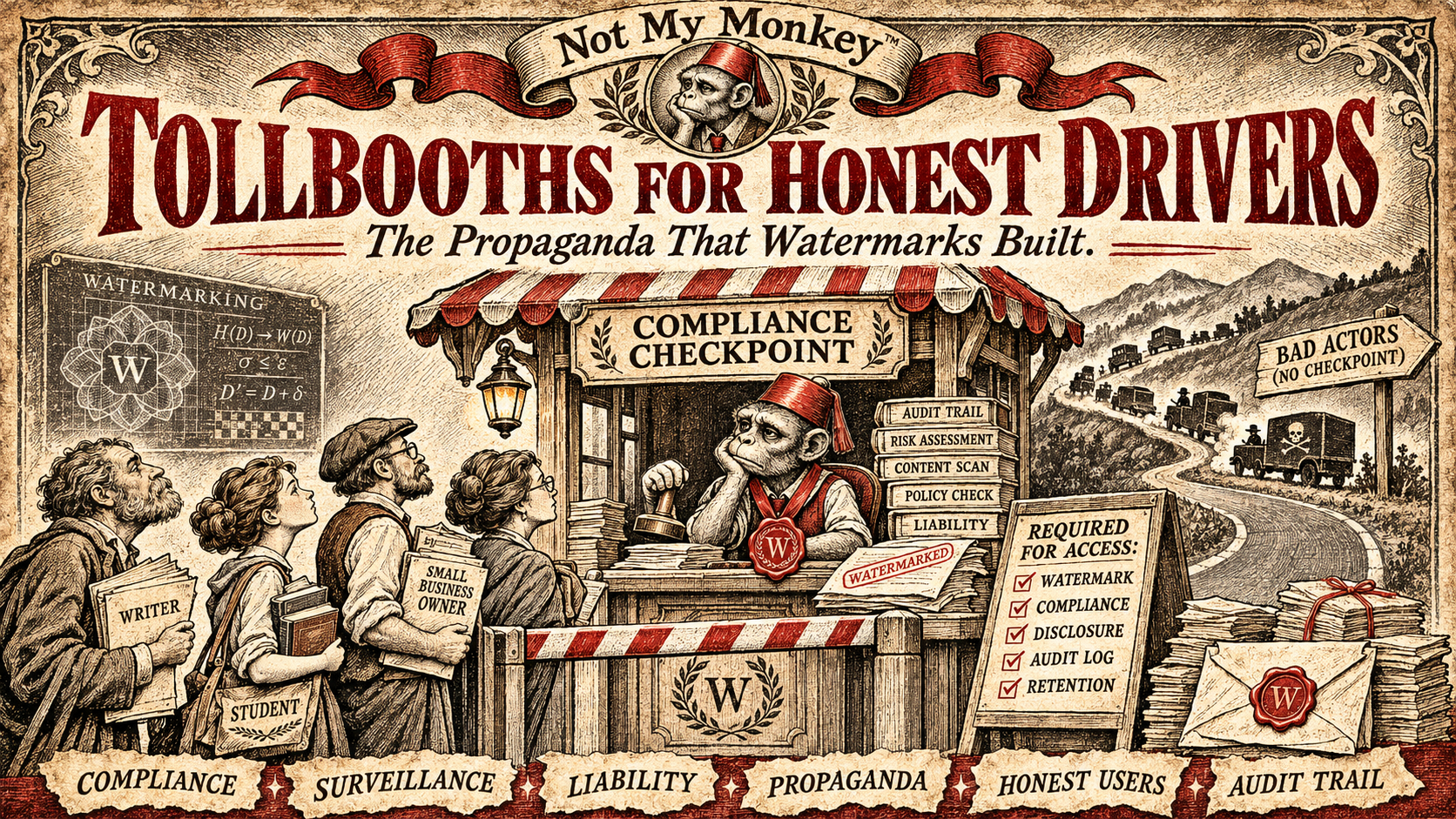
The Propaganda That Watermarks Built
Whenever a tech monopoly prepares to break something useful, it dresses the destruction in the language of a moral crusade.
The narrative rolled out over the past few weeks is as familiar as it is pious. We are told that invisible text watermarking—now quietly stamped into the foundational architectures of Google and Anthropic alike—is a vital, non-negotiable bulwark against societal collapse. It will expose foreign influence operations. It will neutralise state-sponsored disinfo. It will hold back the tidal wave of automated deepfakes threatening our democracies.
It sounds noble. It sounds urgent. It placates the regulators in Brussels, gives corporate communications teams a reassuring script for the press, and allows the companies to present themselves as responsible stewards of human truth.
It is also pure, unadulterated civic theatre.
The Anatomy of an Illusion
To believe that text watermarking stops propaganda, you have to believe in a cartoon version of malicious actors.
You have to imagine a professional disinformation syndicate, a hostile foreign intelligence unit, or a predatory boiler-room operation sitting down at a sleek consumer interface. You have to picture them setting up a commercial subscription, entering a traceable credit card, willingly submitting their IP address, agreeing to a Terms of Service agreement, and politely allowing a California corporate lab to embed a cryptographic tracking seed into their influence campaigns.
The proposition is laughably detached from reality.
Real-world information warfare does not ask permission from an API. It does not queue up behind rate limits. Malicious operations run on open-weights models—freely downloaded, locally hosted, and running on private compute clusters entirely beyond the reach of corporate audit keys. They strip away safety filters with three lines of Python. They generate text natively, silently, and in arbitrary volumes, utterly unwatermarked.
And even if an amateur propagandist did make the mistake of generating a fake news article through a commercial system, the cryptographic "shield" is made of wet tissue paper. Run that watermarked text through a five-second, local open-source paraphraser with a prompt as basic as "rewrite this clearly," and the probability distributions scramble. The green-list pattern shatters. The watermark vanishes into thin air.
The architects of these watermarking systems know this. They understand the mathematics better than anyone on earth. They know their tags cannot stop a determined adversary for even thirty seconds.
Yet they build the machinery anyway.
The Performance of Compliance
If watermarking fails completely at the one task used to justify its existence, why is it here?
Follow the money and the mandates. Under regulatory frameworks like the European Union’s AI Act, frontier AI providers face catastrophic financial liabilities—up to tens of millions of euros or crippling percentages of global turnover—if they fail to provide "machine-detectable" synthetic outputs.
The primary client for text watermarking is not the public, and it certainly isn't the reader. The client is the regulator.
Watermarking exists so that corporate counsel can point to an audit trail during a compliance deposition and say: Look, we did our part. We built the mechanism. It is liability insulation masquerading as counter-espionage. It transforms a thorny, unresolved societal challenge into a box-ticking exercise that costs the tech giants very little to deploy, but buys them immense political cover.
It is the digital equivalent of airport security requiring passengers to remove their shoes: a cumbersome, performative ritual that catches nobody dangerous, but creates the comforting illusion that someone in authority is in control.
The Commuter Highway
So who actually pays the toll?
When you erect a mandatory checkpoint on a public road, the cartels do not line up to be searched. They take the unpaved mountain passes they carved out years ago.
The only people who stop at the tollbooth are the ordinary commuters who had nowhere else to go.
The watermark falls squarely, exclusively, on the honest:
The student wrestling with a thesis structure in a library.
The small business owner drafting marketing copy at a kitchen table.
The researcher summarising dense reports to meet a deadline.
The solitary author spending stolen midnight hours revising dialogue after a grueling shift.
None of these people are manufacturing election interference. None of them are running bot farms. They are simply human beings using a magnificent cognitive mirror to organise their thoughts, refine their words, and make themselves understood.
Yet they are the ones whose private drafting environments are retrofitted with silent surveillance. They are the ones whose creative choices are distorted by engineered synonym biases, whose prose is sanded into sterile predictability, and whose manuscripts are marked with a digital tag that invites suspicion the moment they share their work with the world.
The True Cost of Safety Theatre
The deepest tragedy of this theatre is not merely that it is ineffective. It is that it actively poisons the well.
By pretending that statistical watermarking separates the "authentic" from the "synthetic," the tech industry has legitimised a paranoid cultural dragnet. It encourages institutions, publishers, and employers to rely on crude, statistical gotcha-tools, treating the presence of digital processing as synonymous with fraud.
It creates a world where an honest writer using a tool for developmental guidance is treated like an imposter, while a cynical actor with a rack of local servers floods the internet with untraceable noise, completely unchecked.
The labs have not built a fortress to protect us from disinformation. They have built an administrative turnstile to protect themselves from lawsuits.
They didn't stop the lies. They just put a brand on the truth.